Amrize
\ Overview
Amrize is Holcim’s newly established North American building-solutions company, formed through a major 2025 spin-off to focus exclusively on the U.S. and Canadian construction markets. With over 1,000 sites, 19,000 employees, and USD 11.7B in annual revenue, Amrize is positioned to become one of the region’s leading providers of integrated and sustainable building materials.
As part of this transformation, I led the end-to-end UX design for the Amrize digital platform—creating the complete sitemap, user flows, and all interface pages from the ground up. Collaborating closely with engineers and stakeholders, I delivered a unified platform that presents Amrize’s products, services, and sustainability data in a clear, intuitive, and scalable experience, helping project teams make confident and more sustainable decisions.
Amrize is Holcim’s newly established North American building-solutions company, formed through a major 2025 spin-off to focus exclusively on the U.S. and Canadian construction markets. With over 1,000 sites, 19,000 employees, and USD 11.7B in annual revenue, Amrize is positioned to become one of the region’s leading providers of integrated and sustainable building materials.
As part of this transformation, I led the end-to-end UX design for the Amrize digital platform—creating the complete sitemap, user flows, and all interface pages from the ground up. Collaborating closely with engineers and stakeholders, I delivered a unified platform that presents Amrize’s products, services, and sustainability data in a clear, intuitive, and scalable experience, helping project teams make confident and more sustainable decisions.
\ Sitemap & Navigation
When we began designing the Amrize digital platform, one of the core missions was to rebuild and reorganize the vast, fragmented web of content and product information that originally belonged to Holcim. Across the former Holcim ecosystem existed multiple websites, each showcasing different materials, solutions, and regional offerings — from decarbonized cement and recycled aggregates to specialty building systems, concrete, asphalt, precast solutions, roofing & walling, and more.
This dispersion created a major challenge: valuable information — product specs, sustainability credentials, solution narratives, application contexts — was scattered across domains and pages, making it difficult for users (architects, engineers, contractors, developers) to explore offerings in a holistic, intuitive way. To transform this fragmented landscape, we devoted considerable effort to diving deeply into every existing Holcim website, auditing all products and services, cataloguing every content node, and mapping out how they logically relate to one another.
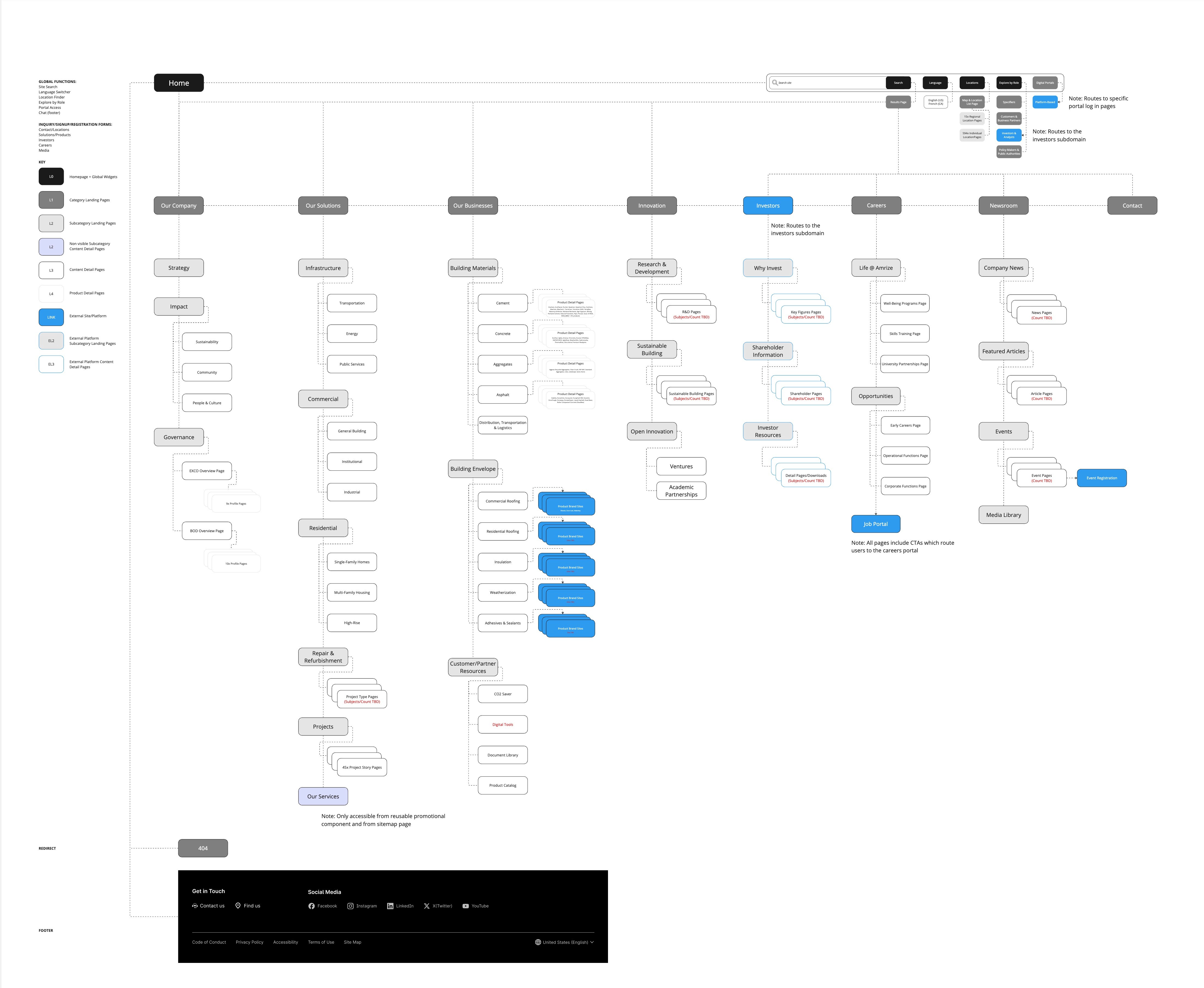
Out of that process we designed a unified, comprehensive sitemap for Amrize — establishing a clear information architecture that organizes all building materials, solutions, applications, and sustainability data under coherent top-level categories. We defined a global navigation and content hierarchy that simplifies discovery, reduces redundancy, and surfaces the full breadth of Amrize’s offerings.
When we began designing the Amrize digital platform, one of the core missions was to rebuild and reorganize the vast, fragmented web of content and product information that originally belonged to Holcim. Across the former Holcim ecosystem existed multiple websites, each showcasing different materials, solutions, and regional offerings — from decarbonized cement and recycled aggregates to specialty building systems, concrete, asphalt, precast solutions, roofing & walling, and more.
This dispersion created a major challenge: valuable information — product specs, sustainability credentials, solution narratives, application contexts — was scattered across domains and pages, making it difficult for users (architects, engineers, contractors, developers) to explore offerings in a holistic, intuitive way. To transform this fragmented landscape, we devoted considerable effort to diving deeply into every existing Holcim website, auditing all products and services, cataloguing every content node, and mapping out how they logically relate to one another.
Out of that process we designed a unified, comprehensive sitemap for Amrize — establishing a clear information architecture that organizes all building materials, solutions, applications, and sustainability data under coherent top-level categories. We defined a global navigation and content hierarchy that simplifies discovery, reduces redundancy, and surfaces the full breadth of Amrize’s offerings.
\ Key Page Templates
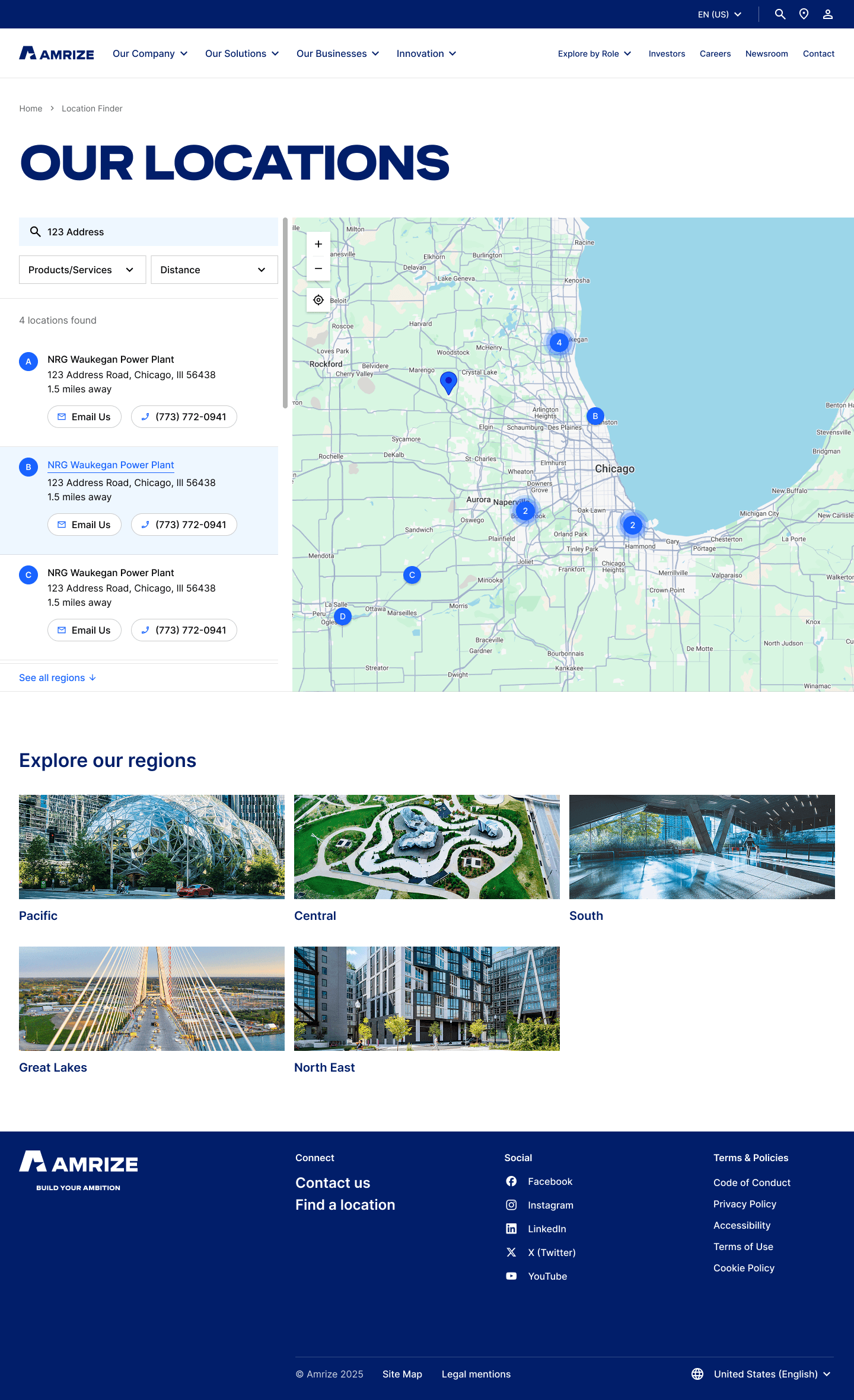
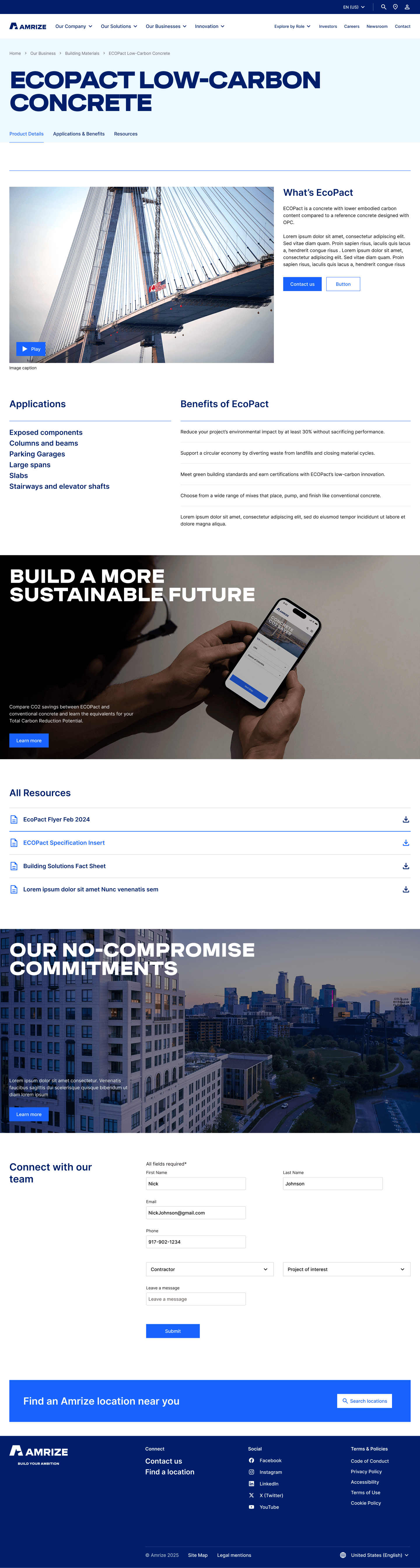
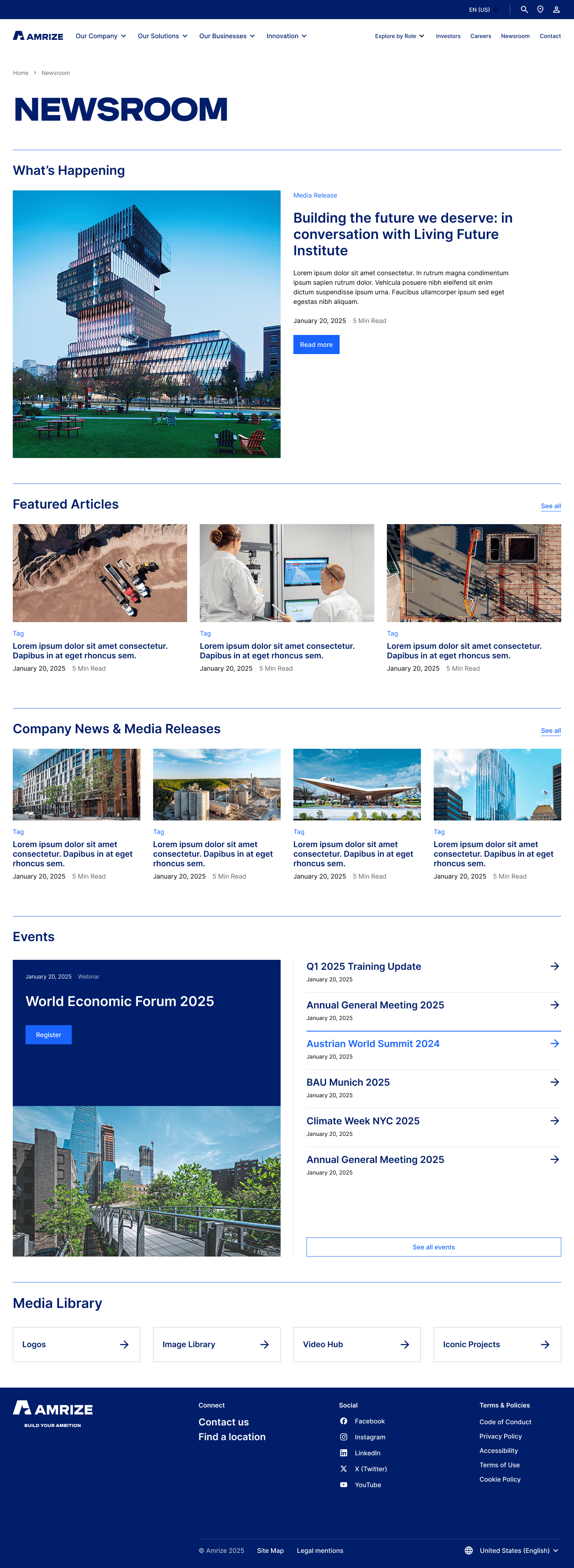
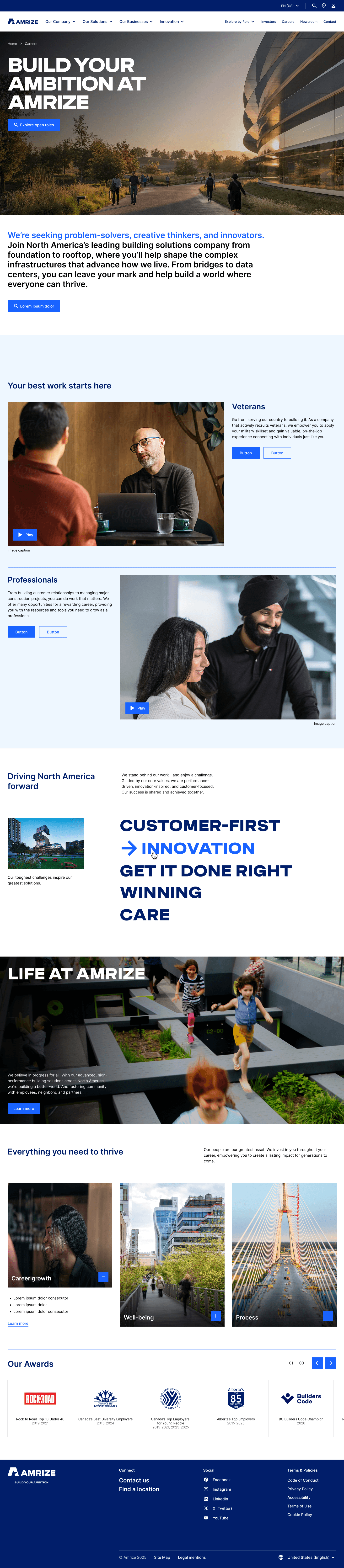
With the unified sitemap established, I moved into designing the complete set of user flows and user-facing pages, ensuring every interaction aligned with the new information architecture. This phase included creating key foundational pages such as the Newsroom, Our Business, Careers, Project Story, Location Finder, Location Detail, and Product Detail pages. These pages served as the core templates for the entire platform; the components, layout systems, and interaction patterns defined here formed the building blocks used to construct the rest of the Amrize website. By collaborating closely with engineers and stakeholders throughout development, we successfully translated this modular, scalable design system into a live platform—transforming previously fragmented content into a cohesive, intuitive, and future-proof digital ecosystem.
With the unified sitemap established, I moved into designing the complete set of user flows and user-facing pages, ensuring every interaction aligned with the new information architecture. This phase included creating key foundational pages such as the Newsroom, Our Business, Careers, Project Story, Location Finder, Location Detail, and Product Detail pages. These pages served as the core templates for the entire platform; the components, layout systems, and interaction patterns defined here formed the building blocks used to construct the rest of the Amrize website. By collaborating closely with engineers and stakeholders throughout development, we successfully translated this modular, scalable design system into a live platform—transforming previously fragmented content into a cohesive, intuitive, and future-proof digital ecosystem.
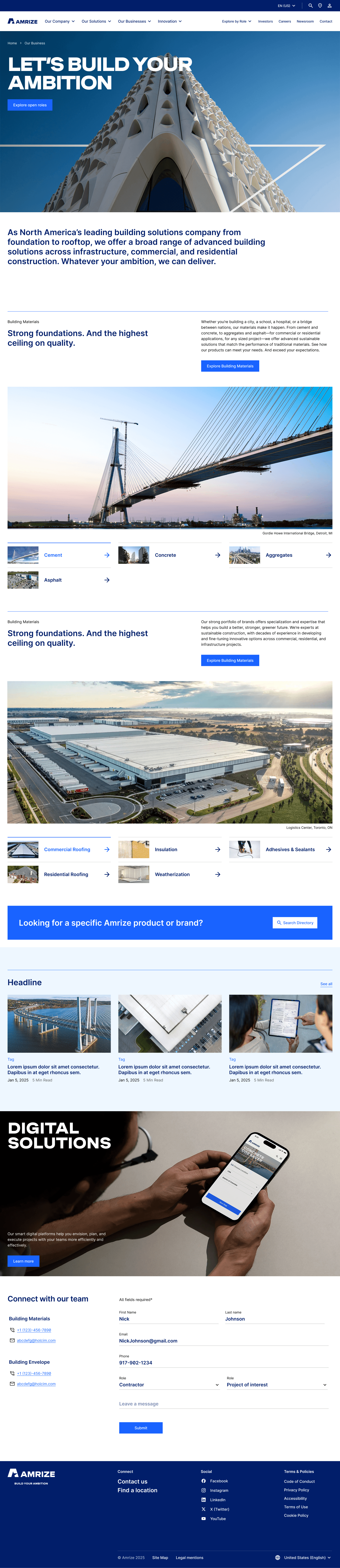
Our Business
Our Business
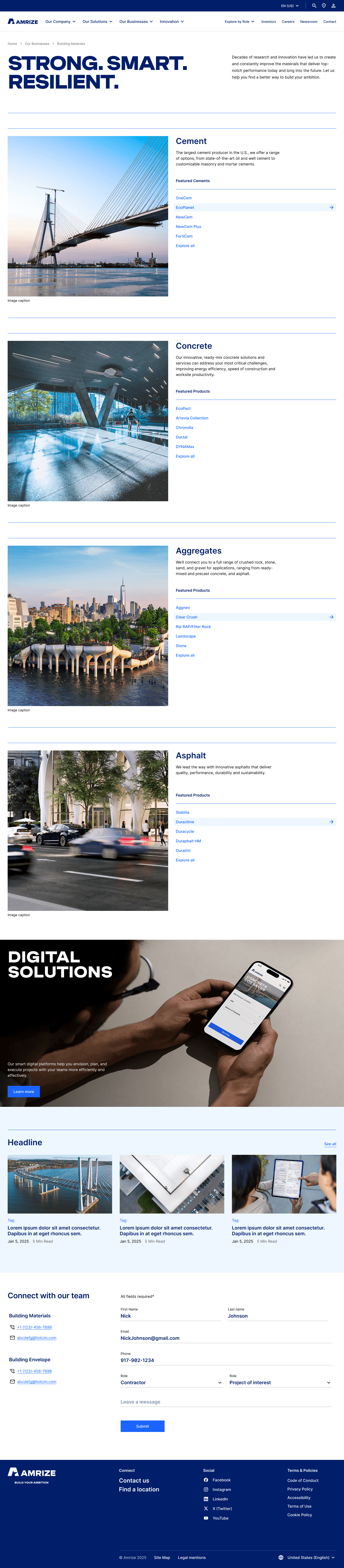
Our Business / Building Materials
Our Business / Building Materials
Our Business / Building Materials / Products
Our Business / Building Materials / Products
Newsroom
Newsroom
Newsroom / Articles
Newsroom / Articles

Careers
Careers
Location Finder
Location Finder